When I was diagnosed with Stage 4 breast cancer, I decided very early on that I wanted to be as involved as possible in my own healing. I knew the medical treatment was important, but I also felt there were many other areas I could support at the same time, including mindset, food, stress, emotional wellbeing, visualisation, purpose and simply bringing more enjoyment back into my life.
One day, my oncologist wished me a happy birthday and I said to him, “I just need you to give me 20 more.”
I challenged him to give me another 20 birthdays.
He looked slightly uncomfortable but intrigued, and the nurse said, “Challenge accepted.”
That became a very clear intention for me. I decided I wanted another 20 years, and I have held onto that ever since. From that point on, I wasn’t just thinking about getting through the next treatment or the next scan. I was thinking about the life I still wanted to live.
Medication and mindset
I can’t talk about the medication without also talking about mindset because, for me, the two have been closely connected.
My oncologist was helpful when I was diagnosed and was as positive as you can be with Stage 4 breast cancer. Because I was strongly HER2-positive, he told me that he had patients who had done very well on Herceptin for many years, and he also shared stories of people who had experienced exceptional responses.
I made a decision that I wanted to be one of those people.
I embraced the medication and found out everything I could about how it worked. I watched the movie Living Proof, which tells the story of the development of Herceptin, and I found that incredibly encouraging. I decided that I wanted to be one of those exceptional responders.
One of the affirmations I regularly use is:
“I am having an exceptional response to the medication.”
My treatment included chemotherapy initially, along with Herceptin and Perjeta, which continue as part of my ongoing treatment. I also take Tamoxifen.
Reading and learning
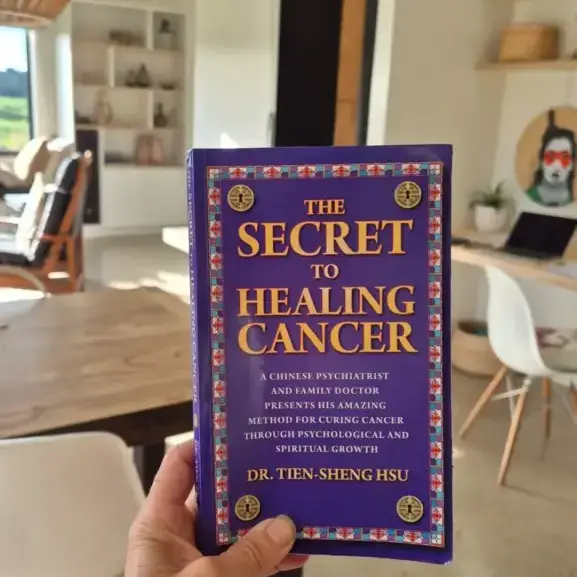
I read Radical Remission and also Eat to Beat Disease by Dr William Li.
I watched one episode of the Radical Remission documentary series and found it really helpful, which is part of what led me to do the Radical Remission course with Justine & Jenny.
I also like reading positive survival stories. I save them on my phone and go back to them because I find they help reinforce the idea that good outcomes are possible.
Food
I have been following a lot of Dr William Li’s work and decided to include many of the foods he talks about regularly.
I have cooked tomatoes two or three times a week, cruciferous vegetables most days, berries most days, dark chocolate, coffee, green tea, walnuts and other tree nuts, cranberries, mushrooms and apples.
For a while I was also juicing fresh carrot, celery and apple. I haven’t done that as much recently but it is something I would like to get back to.
I have also had to adapt my diet around what my body needs. I became anaemic, so I had to make sure I was eating appropriately for that as well.
Supplements and testing
I saw an integrative GP who organised a number of blood tests to see what was going on.
Interestingly, I wasn’t particularly deficient in anything and my blood sugars were good, so I haven’t taken a huge number of supplements.
At the moment I take fish oil, vitamin D and a green tea supplement because I find it difficult to drink enough green tea.
I also plan to see a naturopath for further guidance.
Stress and emotional wellbeing
This has been a big area for me.
I had been through a very stressful period in the years leading up to my diagnosis, particularly around family illness, grief and difficult relationships.
At first I didn’t really know where to start, so I decided to pay attention to anything that gave me a strong physical stress response.
I started noticing the people and situations that triggered that reaction and asking myself what I could actually do about it.
I made a list of the things that caused stress in my life and started looking at each one individually.
Some family relationships had become very strained, so I made a conscious effort to reconnect and improve those relationships. It is still a work in progress, but things are much better and that has reduced a lot of stress for me.
I sometimes jokingly think of it as a “cancer reset.”
I also made the decision to keep my diagnosis very private this time.
I had experienced cancer before and knew what it was like to tell lots of people. This time I only told a very small number of people because I knew that was what would be less stressful for me.
I did not want to constantly manage other people’s fear, negativity or reactions while I was trying to get through treatment.
For me, that was part of looking after myself.
Mindset
Mindset has been a major focus.
I read positive survival stories and save the ones that inspire me.
I use affirmations and regularly remind myself that I am having an exceptional response to treatment.
I try to keep bringing myself back to possibility rather than allowing fear to take over.
Prayer
I pray for myself to heal, and I also pray for other people I know who are going through illness.
Prayer has become another part of my daily routine.
Hypnotherapy and visualisation
I use hypnotherapy and visualisation daily.
Some of the things I visualise include a golden healing light moving through my body, a magic vacuum cleaner sucking up cancer, and miniature doctors inside my body fixing whatever needs attention.
I also imagine going into a control room inside my mind where I can adjust different controls relating to my blood, cancer, healing and response to medication.
Another visualisation I use involves travelling 100 years into the future where the cure for cancer has been found. In that visualisation, I am given the medicine that can heal me.
I enjoy these visualisations and they help me feel involved in what is happening in my body rather than feeling powerless.
Self-healing work
I also completed an introductory self-healing course based on the work of Inna Segal.
I found it intriguing and incorporated some of the techniques into my hypnotherapy practice.
One involved placing my hands over an area of the body and directing healing towards it. I would also talk to my body and say things like, “I’m sorry this happened to you. Do you have any messages for me that will help me help you heal?”
Another practice involved imagining that I was physically removing stress, grief or illness from the body with my hands and then placing it into a purple flame to neutralise it.
I found that especially helpful for clearing stress from the day.
I also began doing inner child work. I listened to several recordings around nurturing the inner child and found that helpful, particularly in relation to reconnecting with family and looking at old emotional patterns.
It is something I would like to explore more.
Having more fun
Another thing I have really tried to do is have more fun.
I realised that cancer is not everything and it is not all of me. It is only one part of my life.
So I started asking myself what I was going to do with the rest of my time.
I joined a choir, went back to a walking group, started going to the movies more regularly and made an effort to get out and explore different places.
I go to art galleries, listen to live music, go to concerts, meet people for coffee and spend more time doing things I enjoy.
I have also started thinking about volunteering in the arts and getting back into doing my own art again.
All of these things help me get out of the cancer headspace.
Purpose
Purpose has also become important.
There are people in my life that I deeply want to be around for, and that gives me a very strong reason to keep going.
I have also been thinking about what else gives my life meaning.
I had been doing hypnotherapy work for many years but had stepped back from it. More recently, a small amount of work has started coming back and I have found that I can manage it.
That feels good because I feel like I am helping someone.
I have also thought about creating a collection of audio recordings for people going through cancer treatment, because those kinds of recordings have helped me so much.
Perhaps part of my purpose right now is simply focusing on healing and then eventually sharing some of what has helped me with others.
Giving up alcohol
Another thing I have done over the past several months is stop drinking alcohol.
That has felt like another simple way of supporting myself and my body.
Staying in the present moment
One of the biggest things I have learned is to stay in the present moment.
Cancer can make you think constantly about the future, treatment, scans and what might happen next.
I have really worked on bringing myself back to now.
The present moment is all we actually have, and learning that has helped me enormously.
There has not been one single thing that I feel has supported me through this experience.
It has been a combination of embracing my medical treatment, working on my mindset, changing the way I respond to stress, looking at my relationships, eating well, using visualisation and hypnotherapy, praying, having more fun, finding purpose and learning to stay present.
For me, it has been about doing everything I can to support myself physically, mentally and emotionally while continuing with my treatment.
Anonymous – Australia
This is one person’s experience and is shared for inspiration only. It is not medical advice and should not be taken as evidence that any particular approach can treat or cure cancer.